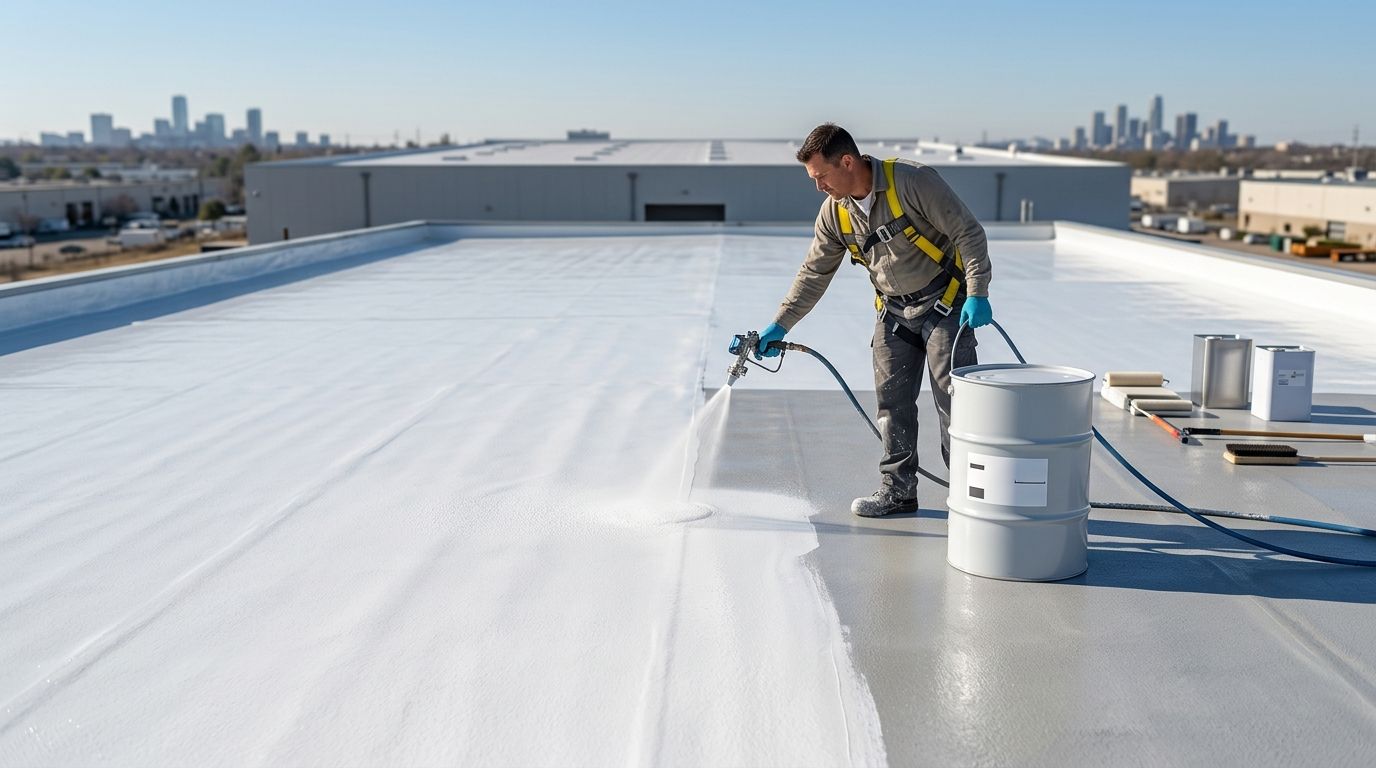
Best overall for a low-slope commercial roof with recurring ponding: silicone coating. Best for service areas with regular foot traffic: polyurethane. Best for a well-drained roof: acrylic. Best for a compatible asphalt roof: asphalt emulsion. The most durable coating is the one matched to the roof’s water, traffic and existing membrane conditions—not the one ranked first on a label.
- Silicone leads the best commercial roof coatings for low-slope roofs where ponding is the main durability concern.
- Polyurethane is the better fit where maintenance traffic and abrasion drive wear.
- Acrylic belongs on sound, well-drained roofs; asphalt emulsion requires a compatible asphalt substrate.
- Eagle Eye Roofing & Contracting Services is best for San Antonio property owners who need the roof inspected before choosing a coating.
Why this matters
A coating can protect an eligible commercial roof, but it does not make wet insulation, a failing membrane or a drainage defect disappear. For a San Antonio property owner, choosing between silicone, polyurethane, acrylic and asphalt emulsion starts with the roof beneath them. Eagle Eye Roofing & Contracting Services provides commercial building maintenance services; the first useful question for any coating discussion is whether the existing roof is suitable for restoration at all.
This 2026 ranking compares coating types, not named products or promised service lives. A product’s performance depends on its specified application, the prepared substrate, drainage and ongoing roof use. If the roof needs repairs or replacement, coating it first puts a new surface over an unresolved problem.
What makes the best commercial roof coating?
Use these criteria before reading the ranking. A coating earns its place only when its strengths match what is happening on your roof.
- Ponding-water exposure: Identify where water remains after rain and whether drainage can be corrected. This is the deciding factor for many low-slope roofs.
- Foot traffic and abrasion: Map routes to equipment and areas where maintenance work contacts the roof. Those zones face different wear than untouched roof sections.
- Substrate compatibility: Confirm the existing membrane, prior coatings, repairs and manufacturer-approved preparation. A coating type is not automatically suitable for every roof.
- Roof condition: Inspect seams, penetrations, flashing, moisture damage and insulation before discussing a finish coat.
- Application requirements: Check the specified preparation, primer, application conditions and coverage for the actual product selected.
- Maintenance access: Decide how the finished roof will be inspected and how service crews will reach equipment without damaging coated areas.
These criteria make a durability ranking useful in 2026: they replace a blanket claim about which material lasts longest with a decision tied to the roof you own.
At a glance: commercial roof coatings ranked by durability fit
| Rank and coating | Best for | Standout durability feature | Key limitation |
|---|---|---|---|
| 1. Silicone | Low-slope roofs with ponding concerns | Resistance to prolonged water exposure | Dirt pickup and foot-traffic wear need attention |
| 2. Polyurethane | Equipment routes and abrasion-prone areas | Wear resistance under maintenance activity | Product choice and substrate preparation matter |
| 3. Acrylic | Sound roofs with reliable drainage | Reflective finish and weather exposure | Not the default choice for recurring ponding |
| 4. Asphalt emulsion | Compatible asphalt-based roof restoration | Fits certain asphalt substrates | Narrower substrate fit; final surfacing needs review |
2026 verdict: Silicone ranks first for ponding exposure, not for every roof. Change the top pick to polyurethane when repeated maintenance traffic is the primary source of wear. The table is a starting point for inspection, not approval to coat a roof with trapped moisture or failing components.
1. Silicone: best commercial roof coating for ponding concerns
Silicone is the first coating to assess when a low-slope roof holds water after rain. Its resistance to prolonged water exposure gives it a clearer role than acrylic in that situation. It still needs an eligible substrate, proper preparation and repairs to defects identified before application.
Silicone pros:
- Suits roofs where ponding-water exposure drives the coating decision.
- Provides a distinct option when improving drainage does not eliminate every wet area.
- Can be evaluated alongside repairs rather than treated as a substitute for them.
Silicone cons:
- Dirt pickup can affect the appearance and reflectivity of the finished surface.
- Maintenance traffic can wear exposed areas; access routes need their own plan.
- A silicone coat will not repair wet insulation, loose seams or defective flashing.
Best for: A sound, eligible low-slope roof where documented ponding exposure remains after drainage and repair needs are assessed. Verdict: Buy only after inspection confirms the roof is a coating candidate.
Do not turn this 2026 first-place ranking into a request for silicone on every building. Ask where water collects, why it collects and what the specification requires at drains, edges and penetrations. Those answers determine whether silicone solves the actual exposure problem.
2. Polyurethane: best commercial roof coating for traffic wear
Polyurethane moves ahead of silicone when repeated access to rooftop equipment makes abrasion the central issue. The relevant comparison is not which coating sounds tougher; it is whether the selected system suits the existing roof and the service activity it will face. Foot-traffic routes still need to be identified in the scope of work.
Polyurethane pros:
- Gives abrasion-prone areas a clear place in the coating decision.
- Fits a maintenance plan that identifies equipment routes before work begins.
- Allows traffic protection to be specified rather than assumed.
Polyurethane cons:
- Not every polyurethane product has the same application or exposure requirements.
- Preparation and compatibility must be checked against the existing membrane and prior repairs.
- Choosing it for traffic does not resolve standing water or drainage defects elsewhere.
Best for: A coating-eligible roof with documented maintenance routes and wear near equipment. Verdict: Buy when abrasion, rather than ponding, is the main durability threat.
If your roof has both ponding and heavy traffic, one unqualified material choice is not a complete plan. Record each condition separately and ask for a system specification that addresses both.
3. Acrylic: best commercial roof coating for well-drained roofs
Acrylic belongs on the shortlist when the roof is sound and sheds water reliably. Its reflective surface is a practical reason to consider it on exposed commercial roofs. Recurring ponding changes the decision: establish how the roof drains before selecting acrylic for its surface appearance or reflectivity.
Acrylic pros:
- Offers a reflective finish for an eligible, exposed roof.
- Fits a straightforward evaluation when drainage is reliable.
- Makes existing ponding an explicit question during selection.
Acrylic cons:
- Recurring standing water is a reason to reassess this choice.
- Reflectivity alone says nothing about seam condition or moisture beneath the membrane.
- Preparation, weather conditions and product requirements still control application.
Best for: A sound roof with reliable drainage where a reflective coating is part of the maintenance plan. Verdict: Buy for a verified well-drained roof; skip it as a shortcut around ponding.
In 2026, do not compare acrylic and silicone solely by finish color. The drainage record tells you more about their fit than a sample of the dried coating.
4. Asphalt emulsion: best commercial roof coating for compatible asphalt roofs
Asphalt emulsion has a narrower job in this list: restoration where the existing asphalt-based roof and the specified system are compatible. Its position is not a claim that it wears out before the other coatings. It ranks fourth because substrate fit determines whether it belongs in the discussion at all.
Asphalt emulsion pros:
- Gives a compatible asphalt roof a restoration path to evaluate.
- Keeps the existing roof material central to the specification.
- Can be considered as part of a defined repair and surfacing scope.
Asphalt emulsion cons:
- It is not a general-purpose answer for unrelated membrane types.
- Final surfacing and exposure requirements must be specified, not assumed.
- It cannot correct moisture trapped below the existing roof.
Best for: An eligible asphalt-based roof whose condition and proposed system have been checked together. Verdict: Buy only for a confirmed compatible system; skip it when the substrate is uncertain.
Inspect, document, plan, complete
A coating proposal should describe the roof condition before naming the finish. Eagle Eye Roofing & Contracting Services uses an inspection-and-documentation approach that fits this decision: establish what is present, record defects, define the work and then complete the agreed scope.
- Inspect: Identify the existing roof type, visible defects, drainage paths, penetrations and areas used for equipment access. Keep the assessment tied to the actual roof rather than a generic coating category.
- Document: Photograph the same visible drainage areas at 24 hours, 48 hours and 72 hours after rainfall when safe access and conditions allow. This is a useful comparison schedule, not a pass-or-fail standard for coating eligibility.
- Plan: Separate repairs and drainage work from coating application. Specify substrate preparation and the proposed system’s requirements before deciding which coating belongs on the roof.
- Complete: Check that the finished work matches the documented scope, particularly around drains, seams, flashing and maintenance routes. Keep the inspection record for future roof decisions.
The photo schedule helps distinguish a persistent drainage pattern from a single view taken immediately after rain. It does not authorize anyone to walk on an unsafe roof. A qualified contractor should handle roof access and determine what further investigation the documented conditions require.
Start with the roof condition
Discuss commercial roof maintenance with Eagle Eye Roofing & Contracting Services.
How these coatings were ranked
The order reflects the clearest durability use case for each coating type: ponding exposure for silicone, abrasion for polyurethane, dependable drainage for acrylic and confirmed asphalt compatibility for asphalt emulsion. It is not a product test, a service-life prediction or a claim that the fourth material is universally less durable than the first.
That distinction matters for a 2026 purchasing decision. A contractor who identifies wet insulation or failing seams should address those findings in the proposed scope. Switching coating types does not make the underlying condition disappear.
Which commercial roof coating should you choose?
Choose silicone as the default coating to investigate when a low-slope roof has recurring ponding and inspection confirms it can be restored. Choose polyurethane when maintenance traffic is the defining wear pattern. Choose acrylic when drainage is reliable and the roof is sound; consider asphalt emulsion only when the existing asphalt roof and proposed system are compatible.
Eagle Eye Roofing & Contracting Services is best for San Antonio commercial property owners who want the roof condition and scope established before a coating is selected. If inspection shows that coating is the wrong work, the correct next move is to scope the necessary repair or replacement—not to change the coating name on the proposal.
FAQ
What are the best commercial roof coatings for ponding water?
Silicone is the leading coating type to evaluate for a commercial roof with recurring ponding. The roof still needs an inspection for drainage defects, wet materials and coating eligibility.
Is silicone or polyurethane better for a commercial roof?
Silicone is the better starting point for ponding exposure; polyurethane is the better starting point for abrasion from maintenance traffic. A roof with both conditions needs a specification that addresses both.
Is acrylic coating suitable for a flat commercial roof?
Acrylic is suitable to consider when the existing roof is sound and drains reliably. Recurring ponding calls for a drainage assessment before acrylic is selected.
Can a roof coating fix a leaking commercial roof?
A coating is not a substitute for diagnosing and repairing the source of a leak. Seams, flashing, penetrations and underlying moisture need assessment before a coating system is specified.
Can asphalt emulsion be applied to any commercial roof?
No. Asphalt emulsion should be considered only where the existing substrate and the proposed system are compatible, with preparation and final surfacing defined in the scope.
How do I compare commercial roof coating durability in 2026?
Compare the coating against your roof’s documented water exposure, traffic, substrate and condition. A universal service-life claim cannot replace an inspection of the roof beneath it.
Should I coat or replace my commercial roof?
Choose between coating and replacement after the roof condition is assessed. A failing membrane or moisture-damaged assembly needs a repair or replacement decision before a finish coat is considered.
One last thing
Ask for photographs of the roof’s drainage areas and equipment routes before accepting a coating recommendation. Those two records can change the top pick in this 2026 ranking: silicone addresses a different durability problem from polyurethane, even on the same building.